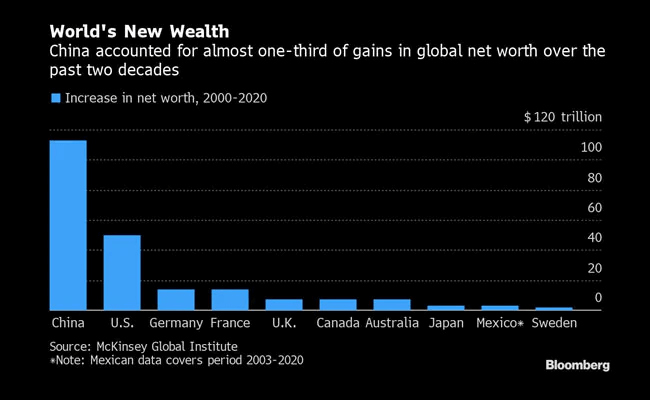
Global wealth tripled over the last two decades, with China leading the way and overtaking the U.S. for the top spot worldwide.
That’s one of the takeaways from a new report by the research arm of consultants McKinsey & Co. that examines the national balance sheets of ten countries representing more than 60% of world income.
“We are now wealthier than we have ever been,” Jan Mischke, a partner at the McKinsey Global Institute in Zurich, said in an interview.

Net worth worldwide rose to $514 trillion in 2020, from $156 trillion in 2000, according to the study. China accounted for almost one-third of the increase. Its wealth skyrocketed to $120 trillion from a mere $7 trillion in 2000, the year before it joined the World Trade Organization, speeding its economic ascent.
Richest 10%
The U.S., held back by more muted increases in property prices, saw its net worth more than double over the period, to $90 trillion.
In both countries — the world’s biggest economies — more than two-thirds of the wealth is held by the richest 10% of households, and their share has been increasing, the report said.
As computed by McKinsey, 68% of global net worth is stored in real estate. The balance is held in such things as infrastructure, machinery and equipment and, to a much lesser extent, so-called intangibles like intellectual property and patents.
Financial assets are not counted in the global wealth calculations because they are effectively offset by liabilities: A corporate bond held by an individual investor, for instance, represents an I.O.U. by that company.
‘Side Effects’
The steep rise in net worth over the past two decades has outstripped the increase in global gross domestic product and has been fueled by ballooning property prices pumped up by declining interest rates, according to McKinsey. It found that asset prices are almost 50% above their long-run average relative to income. That raises questions about the sustainability of the wealth boom.
“Net worth via price increases above and beyond inflation is questionable in so many ways,” Mischke said. “It comes with all kinds of side effects.”
Surging real-estate values can make home ownership unaffordable for many people and increase the risk of a financial crisis — like the one that hit the U.S. in 2008 after a housing bubble burst. China could potentially run into similar trouble over the debt of property developers like China Evergrande Group.
The ideal resolution would be for the world’s wealth to find its way into more productive investments that expand global GDP, according to the report. The nightmare scenario would be a collapse in asset prices that could erase as much as one-third of global wealth, bringing it more in line with world income.